

This chapter follows the core ideas from Chapter 1 (Abstract Data Types) in the Necaise book: define behavior first, then implement it.
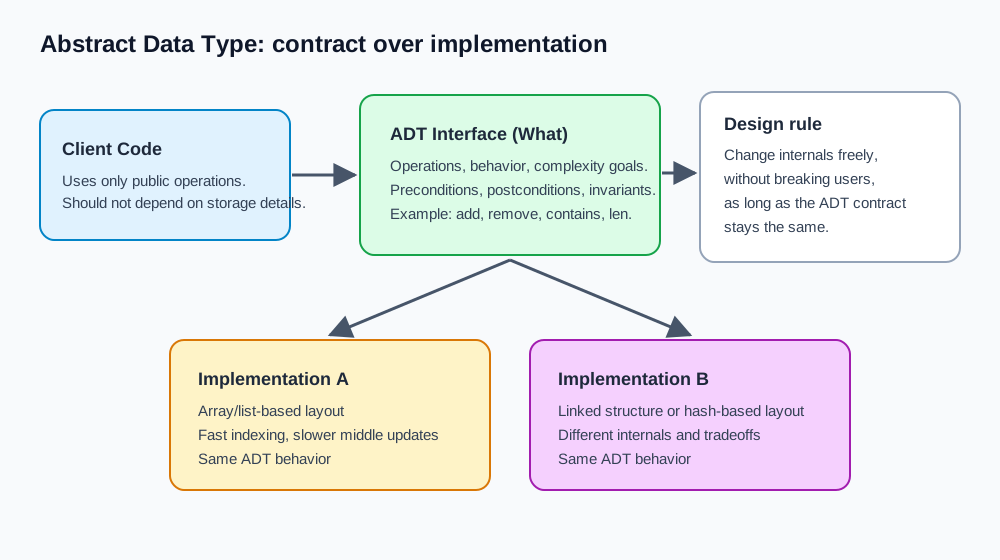
What an ADT gives you
An ADT is a contract:
- It defines what operations exist and what they do.
- It hides how data is stored internally.
- It lets you swap implementations without changing client code.
This separation is the main reason ADTs scale in larger projects.
Core contract pieces
Every operation should be specified with:
- Preconditions: what must be true before the call.
- Postconditions: what must be true after the call.
- Representation invariants: properties that are always true for internal state.
Example for pop() on a stack:
- Precondition: stack is not empty.
- Postcondition: top element is removed and returned.
- Invariant still holds: stack order remains LIFO.
Preconditions and assertions
When learning data structures, assertions are useful for making contracts explicit.
class Stack:
    def __init__(self):
        self._items = []

    def pop(self):
        assert len(self._items) > 0, "precondition failed: stack must be non-empty"
        return self._items.pop()
In production systems, you usually raise specific exceptions for invalid operations.
Multiple implementations, same ADT
A queue ADT can have different implementations:
listbaseddequebased- linked-list based
As long as each implementation preserves queue semantics (FIFO), user-facing code stays the same.
def process_jobs(queue):
    while not queue.is_empty():
        job = queue.dequeue()
        handle(job)
process_jobs should not care about internal storage layout.
Why this matters before coding structures
If you define the ADT contract first, then implementation work in later chapters is easier:
- Arrays/vectors become one possible implementation choice.
- Linked structures become another.
- Performance tuning does not force API rewrites.
This is the foundation for the rest of the data structures section.