

This page follows Chapter 4 (Multi-Dimensional Arrays) from the Necaise book.
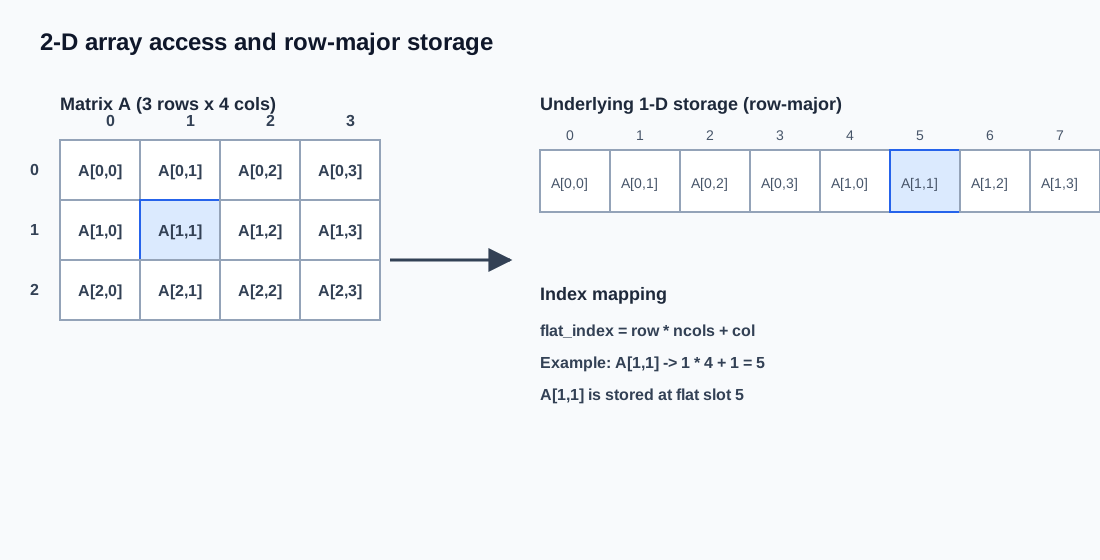
2-D array model
A two-dimensional array stores values in rows and columns, addressed by (row, col).
Typical ADT operations:
num_rows()num_cols()clear(value)get(row, col)set(row, col, value)
Row-major mapping
Even when you write a[row, col], implementations often store data in one flat array.
If ncols is the column count:
flat_index = row * ncols + col
This mapping explains why index translation is constant time.
Minimal Python implementation
class Array2D:
    def __init__(self, nrows, ncols, fill=None):
        if nrows <= 0 or ncols <= 0:
            raise ValueError("nrows and ncols must be > 0")
        self._nrows = nrows
        self._ncols = ncols
        self._data = [fill] * (nrows * ncols)

    def num_rows(self):
        return self._nrows

    def num_cols(self):
        return self._ncols

    def _flat_index(self, row, col):
        if row < 0 or row >= self._nrows or col < 0 or col >= self._ncols:
            raise IndexError("index out of range")
        return row * self._ncols + col

    def get(self, row, col):
        return self._data[self._flat_index(row, col)]

    def set(self, row, col, value):
        self._data[self._flat_index(row, col)] = value

    def clear(self, value):
        for i in range(len(self._data)):
            self._data[i] = value
Matrix ADT operations
The same chapter introduces a matrix ADT with structured operations:
scale_by(scalar)transpose()add(rhs)subtract(rhs)multiply(rhs)
These operations require dimension rules:
- Add/subtract: same shape.
- Multiply: left
ncolsmust equal rightnrows.
Here are two of those operations in full; subtract and element-wise multiply follow the same nested-loop shape.
def transpose(matrix):
    return [[matrix[r][c] for r in range(len(matrix))] for c in range(len(matrix[0]))]


def add(a, b):
    return [[a[r][c] + b[r][c] for c in range(len(a[0]))] for r in range(len(a))]


m = [[1, 2, 3], [4, 5, 6]]
print(transpose(m))     # [[1, 4], [2, 5], [3, 6]]
print(add(m, m))        # [[2, 4, 6], [8, 10, 12]]
Complexity summary
| Operation | Complexity |
|---|---|
get, set |
O(1) |
clear |
O(r * c) |
| Matrix add/subtract | O(r * c) |
| Matrix multiply (naive) | O(r * k * c) |
| Transpose | O(r * c) |
Practical note for Python
Use this ADT for learning index mapping and matrix contracts.
For heavy numerical workloads, prefer NumPy for optimized vectorized operations.