

A linked list stores values in nodes, and each node points to the next node. Unlike arrays, nodes do not need contiguous memory.
Book alignment (Chapter 7: Linked Structures)
This page follows the chapter flow:
- objects/references and singly linked layout
- prepend/remove operations
- iterator-based traversal
- tail reference optimization for
append - sorted linked-list behavior (early stop during search/delete)
One important chapter takeaway: traversal and search are linear, but pointer rewiring for local structural updates is cheap.
When to use linked lists
- You insert or delete near the head frequently.
- You want predictable
O(1)prepend. - You can trade random access speed for update flexibility.
- You need stable node references while changing structure.
When not to use linked lists
- You need fast random index access.
- You do many membership checks by value (
O(n)each). - Memory overhead per element matters more than update flexibility.
Node model
Each node has:
value: payload data.next: pointer to the next node.
Invariants to maintain:
- If list is empty, both
headandtailareNone. - If list is non-empty,
tail.nextis alwaysNone. sizealways matches actual node count.
Operations
prepend(value)
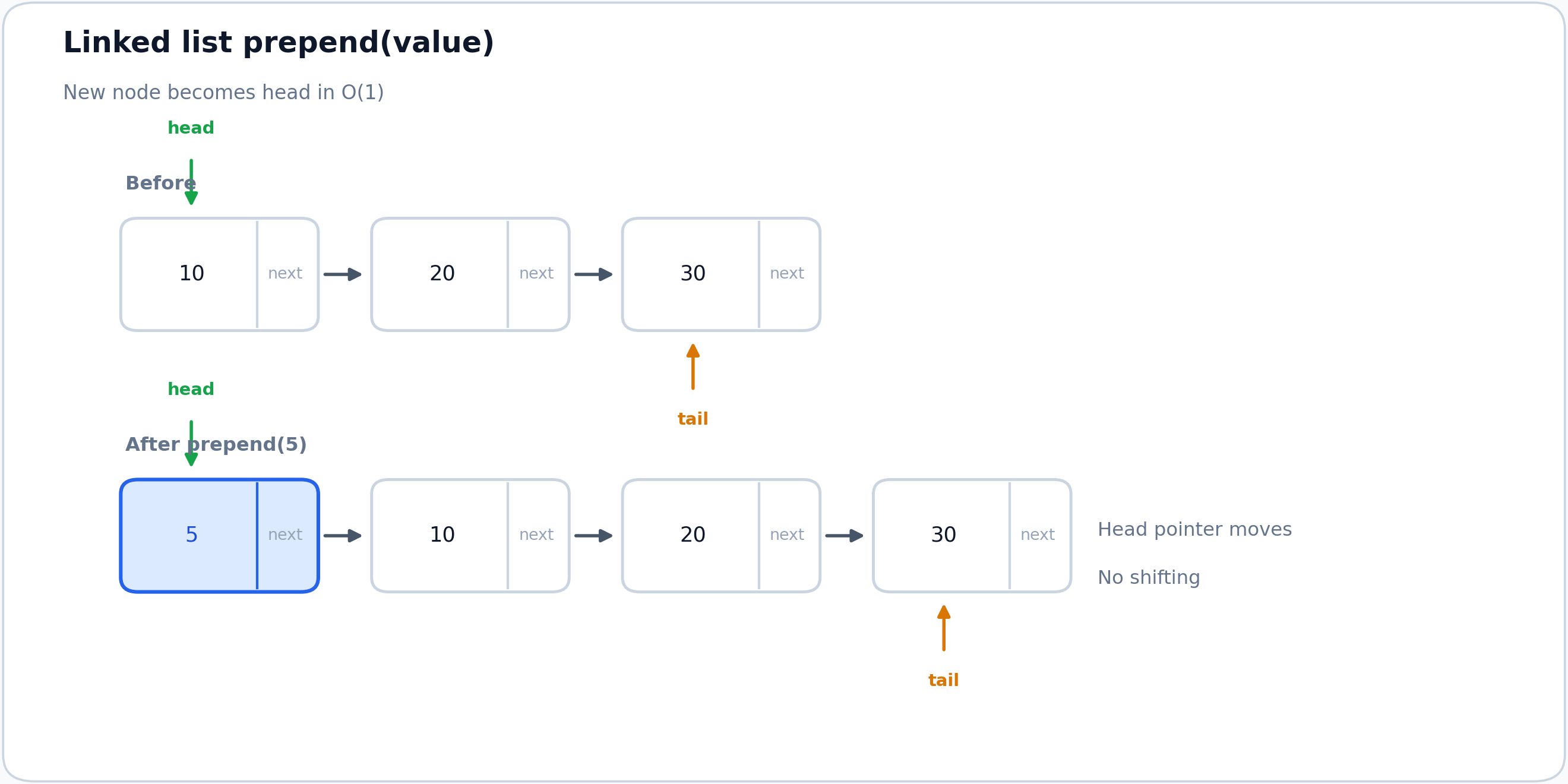
Create a new node, point it to the current head, then move head to this new node.
def prepend(self, value):
    node = Node(value, self.head)
    self.head = node
    if self.tail is None:
        self.tail = node
    self.size += 1
append(value)
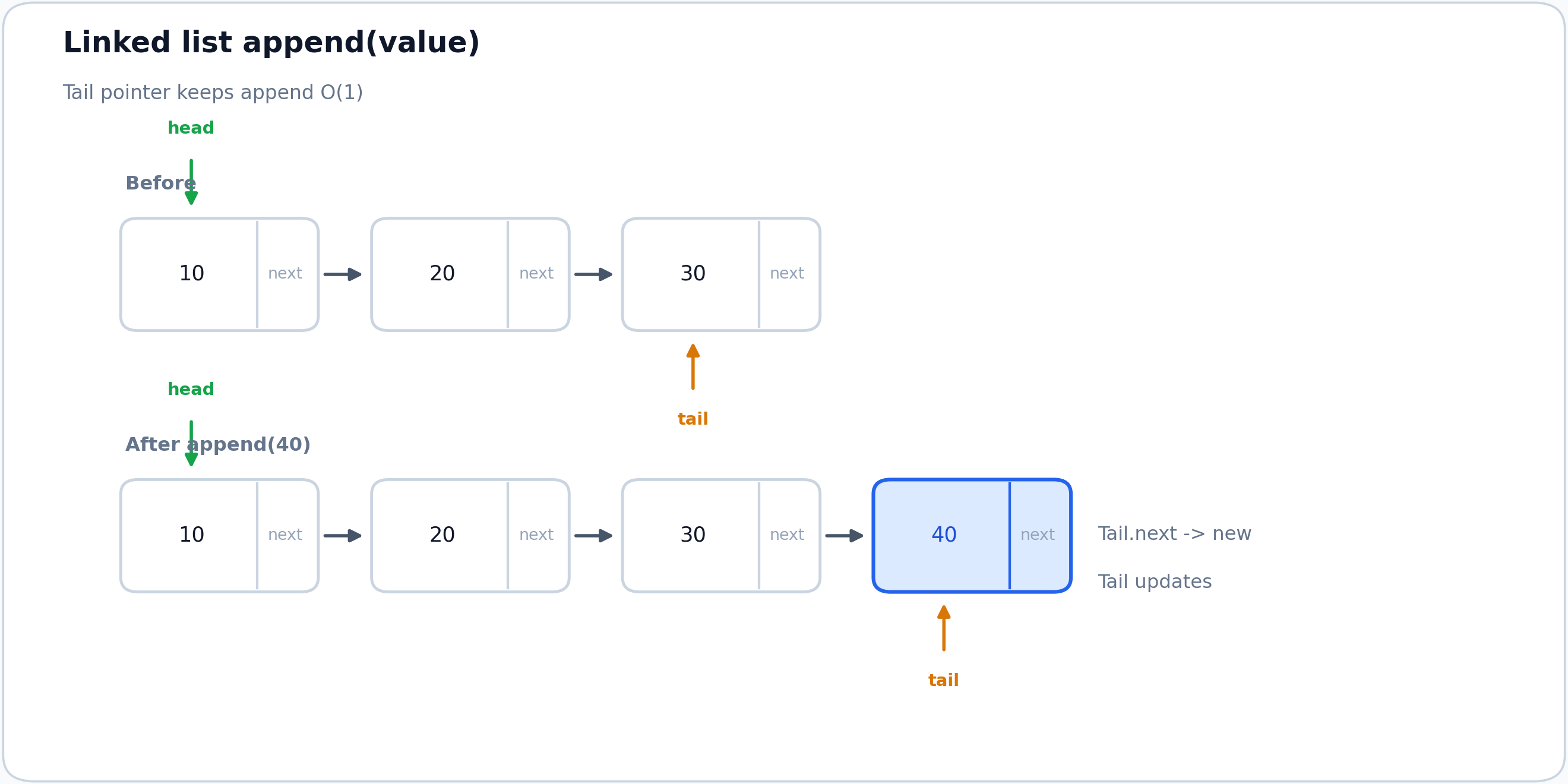
With a tail pointer, append is direct: link tail.next to the new node, then move tail.
def append(self, value):
    node = Node(value)
    if self.tail is None:
        self.head = self.tail = node
    else:
        self.tail.next = node
        self.tail = node
    self.size += 1
find(value)
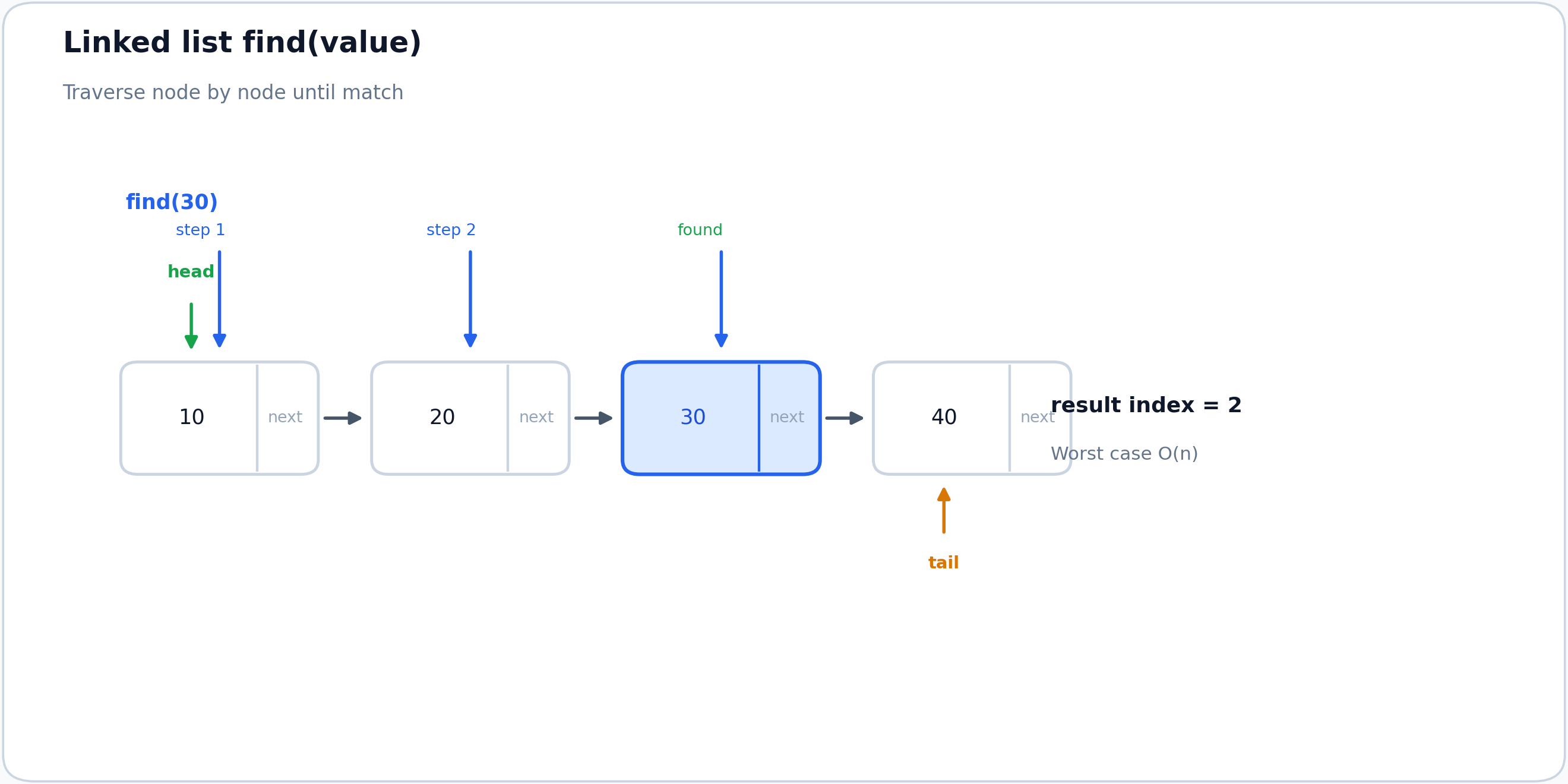
Start from head and walk node by node until a match is found or the list ends.
def find(self, value):
    index = 0
    current = self.head
    while current is not None:
        if current.value == value:
            return index
        current = current.next
        index += 1
    return -1
delete(value)
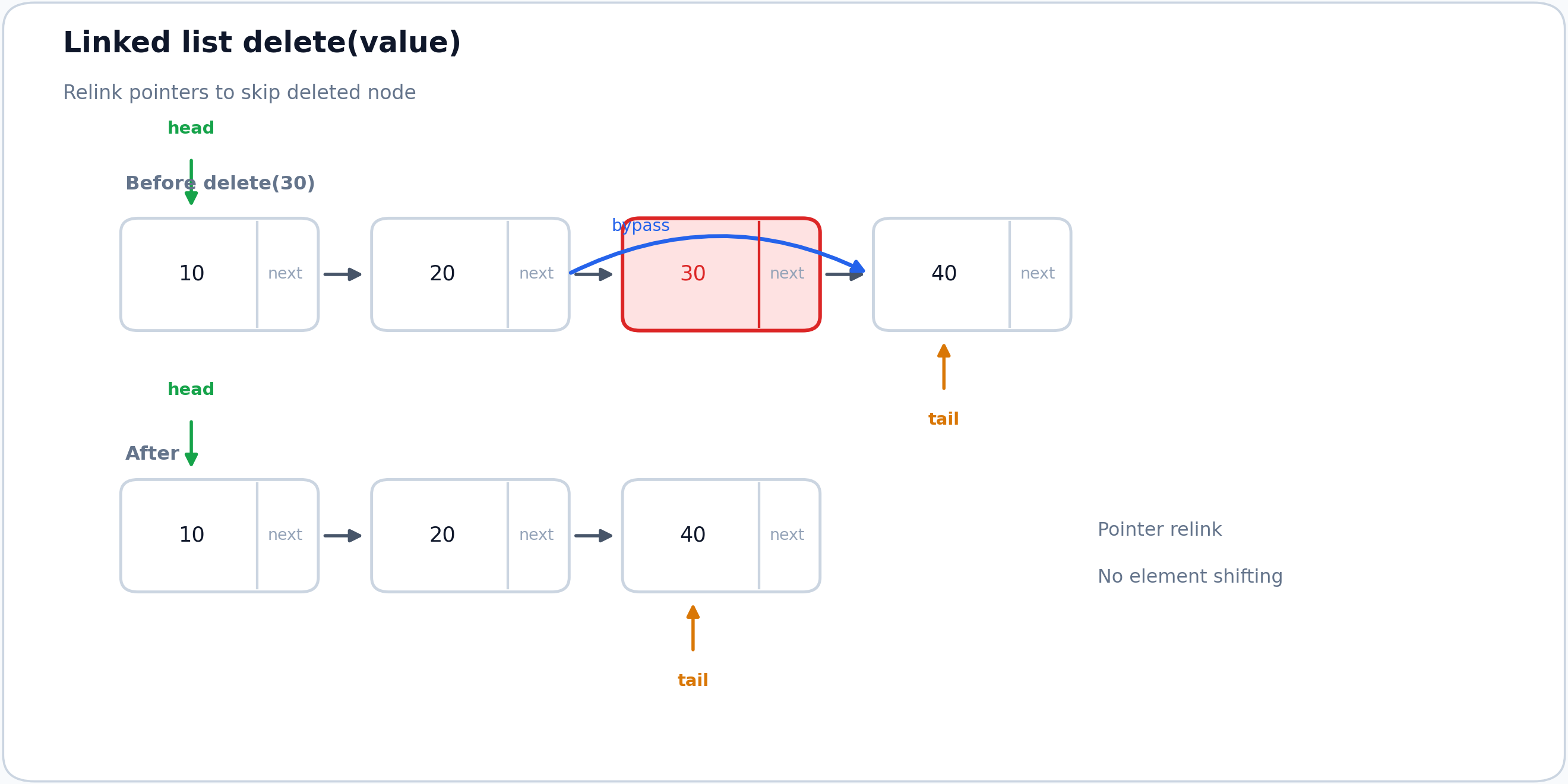
Track previous and current. When current.value matches, skip current by setting previous.next = current.next.
def delete(self, value):
    previous = None
    current = self.head

    while current is not None:
        if current.value == value:
            if previous is None:
                self.head = current.next
            else:
                previous.next = current.next

            if current is self.tail:
                self.tail = previous

            self.size -= 1
            return True

        previous = current
        current = current.next

    return False
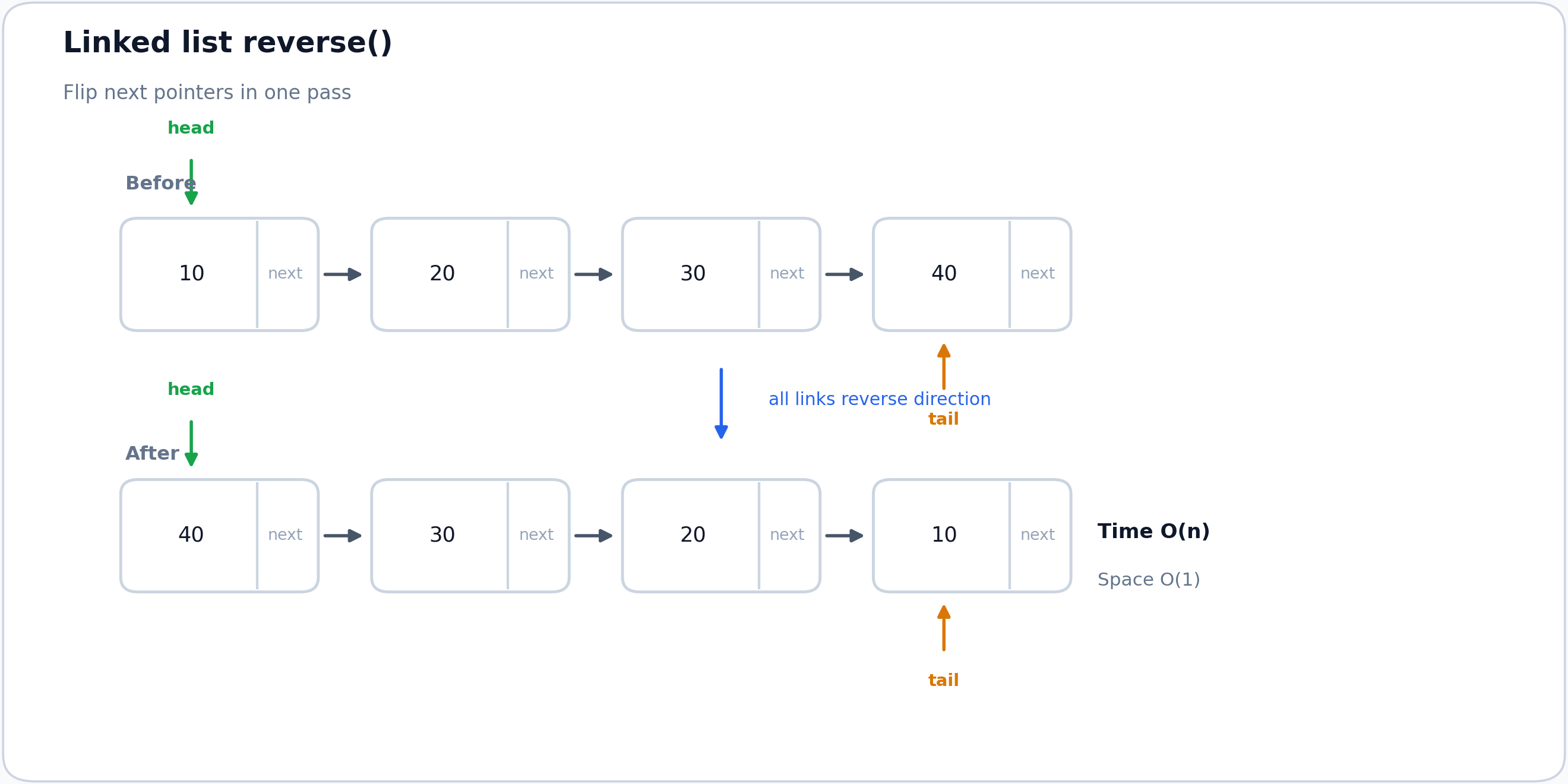
reverse()
Move through nodes once and flip each next pointer to the previous node.
def reverse(self):
    previous = None
    current = self.head
    self.tail = self.head

    while current is not None:
        nxt = current.next
        current.next = previous
        previous = current
        current = nxt

    self.head = previous
Full implementation
class Node:
    def __init__(self, value, next_node=None):
        self.value = value
        self.next = next_node


class LinkedList:
    def __init__(self):
        self.head = None
        self.tail = None
        self.size = 0

    def prepend(self, value):
        node = Node(value, self.head)
        self.head = node
        if self.tail is None:
            self.tail = node
        self.size += 1

    def append(self, value):
        node = Node(value)
        if self.tail is None:
            self.head = self.tail = node
        else:
            self.tail.next = node
            self.tail = node
        self.size += 1

    def find(self, value):
        index = 0
        current = self.head
        while current is not None:
            if current.value == value:
                return index
            current = current.next
            index += 1
        return -1

    def delete(self, value):
        previous = None
        current = self.head

        while current is not None:
            if current.value == value:
                if previous is None:
                    self.head = current.next
                else:
                    previous.next = current.next

                if current is self.tail:
                    self.tail = previous

                self.size -= 1
                return True

            previous = current
            current = current.next

        return False

    def reverse(self):
        previous = None
        current = self.head
        self.tail = self.head

        while current is not None:
            nxt = current.next
            current.next = previous
            previous = current
            current = nxt

        self.head = previous

    def to_list(self):
        result = []
        current = self.head
        while current is not None:
            result.append(current.value)
            current = current.next
        return result
Complexity summary
| Operation | Time | Why |
|---|---|---|
| Prepend | O(1) |
Head pointer update |
| Append (with tail pointer) | O(1) |
Tail pointer update |
| Find | O(n) |
Sequential traversal |
| Delete by value | O(n) |
Search + relink |
| Reverse | O(n) |
One pass through nodes |
Cycle detection (Floyd's algorithm)
Two pointers move at different speeds. If a cycle exists, the fast pointer will meet the slow pointer.
def has_cycle(head):
    slow = head
    fast = head

    while fast is not None and fast.next is not None:
        slow = slow.next
        fast = fast.next.next
        if slow is fast:
            return True

    return False
- Time:
O(n) - Space:
O(1)
Practical notes
- A doubly linked list adds
prevpointer to make delete from middle easier. - Sentinel (dummy) head/tail nodes can reduce special-case branching.
- Python's
collections.dequeis usually preferable for queue/stack behavior.
Typical mistakes
- Forgetting to update
tailwhen deleting the last node. - Not handling empty list and single-node list as special states.
- Assuming linked list supports fast index access like arrays.