

A Bag (also called a multiset) is an unordered collection that allows duplicate elements. Unlike a set, it keeps track of how many times each item appears. Unlike a list, it does not maintain insertion order or support index access.
Book alignment (Chapter 2: Data Structures)
This page is based on the chapter parts:
2.1Bags2.4Iterators2.7-2.10Maps and map operations (conceptual relation)
The Necaise presentation treats bag as a clean ADT that exposes only container-safe operations (add, remove, membership, traversal), preventing misuse of lower-level storage details.
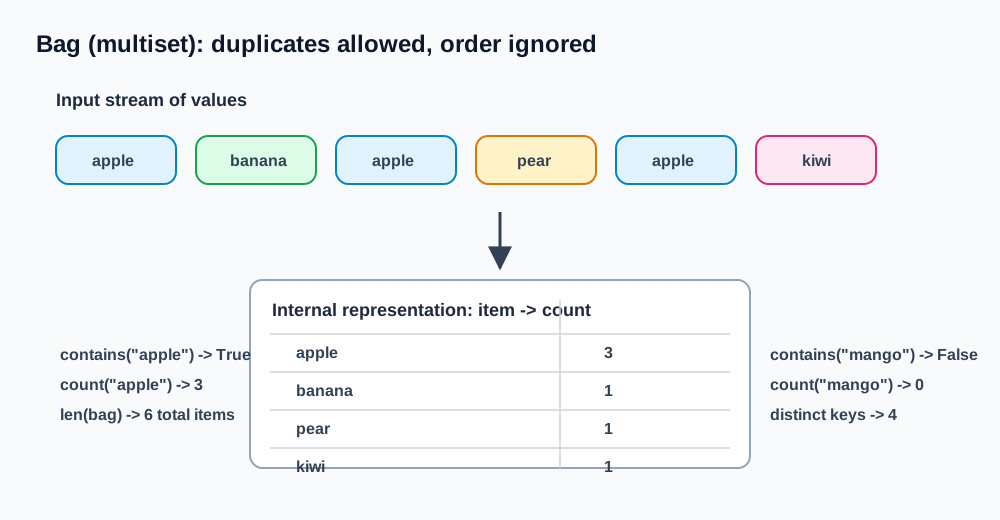
Bag and map relationship
A practical bag implementation is usually backed by a map from item -> count.
- Bag API remains multiset-focused.
- Map API manages key/value storage and replacement.
- Iterator support provides safe traversal without exposing internals.
Core idea
A bag answers two fundamental questions:
- Does this item exist? →
contains(item) - How many copies are there? →
count(item)
Internally a bag is built on a hash map from item → frequency. This gives constant-time add, remove, and count for most inputs.
When to use a bag
- Frequency counting (word histograms, character frequencies).
- Checking whether one collection is a sub-bag of another.
- Multiset arithmetic (union, intersection, difference).
- Anywhere order does not matter but duplicates do.
When not to use a bag
- You need order-sensitive operations (sorting, rank, index access).
- You need range queries (
<= x, betweenaandb) where tree-based structures work better. - You need stable insertion order for iteration output.
Operations
add(item)
Increment the stored count for item by one.
def add(self, item):
    self._counts[item] = self._counts.get(item, 0) + 1
    self._size += 1
remove(item)
Decrement the count for item. If the count reaches zero the entry is deleted. Raises ValueError if the item is absent.
def remove(self, item):
    if self._counts.get(item, 0) == 0:
        raise ValueError(f"{item!r} not in bag")
    self._counts[item] -= 1
    if self._counts[item] == 0:
        del self._counts[item]
    self._size -= 1
count(item)
Return the number of times item appears. Returns 0 for absent items.
def count(self, item):
    return self._counts.get(item, 0)
contains(item)
Return True if the item appears at least once.
def contains(self, item):
    return self._counts.get(item, 0) > 0
is_sub_bag(other)
Return True if every item in self appears at least as many times in other.
def is_sub_bag(self, other):
    for item, cnt in self._counts.items():
        if other.count(item) < cnt:
            return False
    return True
union(other)
Return a new bag where each item's count is the maximum of the two bags.
def union(self, other):
    result = Bag(self)
    for item, cnt in other._counts.items():
        if cnt > result.count(item):
            result._counts[item] = cnt
    result._size = sum(result._counts.values())
    return result
intersection(other)
Return a new bag where each item's count is the minimum of the two bags.
def intersection(self, other):
    result = Bag()
    for item, cnt in self._counts.items():
        keep = min(cnt, other.count(item))
        if keep > 0:
            result._counts[item] = keep
    result._size = sum(result._counts.values())
    return result
Full implementation
class Bag:
    """Unordered collection with duplicate tracking (multiset)."""

    def __init__(self, iterable=()):
        self._counts = {}
        self._size = 0
        for item in iterable:
            self.add(item)

    # ── core ──────────────────────────────────────────────────────────

    def add(self, item):
        self._counts[item] = self._counts.get(item, 0) + 1
        self._size += 1

    def remove(self, item):
        if self._counts.get(item, 0) == 0:
            raise ValueError(f"{item!r} not in bag")
        self._counts[item] -= 1
        if self._counts[item] == 0:
            del self._counts[item]
        self._size -= 1

    def count(self, item):
        return self._counts.get(item, 0)

    def contains(self, item):
        return self._counts.get(item, 0) > 0

    # ── set-like operations ────────────────────────────────────────────

    def is_sub_bag(self, other):
        return all(other.count(item) >= cnt for item, cnt in self._counts.items())

    def union(self, other):
        result = Bag(self)
        for item, cnt in other._counts.items():
            if cnt > result.count(item):
                result._counts[item] = cnt
        result._size = sum(result._counts.values())
        return result

    def intersection(self, other):
        result = Bag()
        for item, cnt in self._counts.items():
            keep = min(cnt, other.count(item))
            if keep > 0:
                result._counts[item] = keep
        result._size = sum(result._counts.values())
        return result

    def difference(self, other):
        """Items in self that are not covered by other, by count."""
        result = Bag()
        for item, cnt in self._counts.items():
            keep = max(0, cnt - other.count(item))
            if keep > 0:
                result._counts[item] = keep
        result._size = sum(result._counts.values())
        return result

    # ── dunder ────────────────────────────────────────────────────────

    def __len__(self):
        return self._size

    def __contains__(self, item):
        return self.contains(item)

    def __iter__(self):
        """Yield each item repeated by its count."""
        for item, cnt in self._counts.items():
            for _ in range(cnt):
                yield item

    def __repr__(self):
        pairs = ", ".join(f"{k!r}: {v}" for k, v in self._counts.items())
        return f"Bag({{{pairs}}})"
Usage examples
b = Bag(["apple", "banana", "apple", "cherry", "apple"])

print(b.count("apple"))        # 3
print(b.count("grape"))        # 0
print("banana" in b)           # True
print(len(b))                  # 5

b.add("banana")
print(b.count("banana"))       # 2

b.remove("apple")
print(b.count("apple"))        # 2

# Sub-bag check
a = Bag(["apple", "apple"])
print(a.is_sub_bag(b))         # True

# Intersection
x = Bag(["apple", "apple", "banana", "date"])
y = Bag(["apple", "banana", "banana"])
print(x.intersection(y))       # Bag({'apple': 1, 'banana': 1})

# Union
print(x.union(y))              # Bag({'apple': 2, 'banana': 2, 'date': 1})
Real-world examples
- Counting log levels (
ERROR,WARN,INFO) in streaming observability pipelines. - Inventory quantities by item ID in e-commerce carts.
- Word frequency vectors for search indexing and text analytics.
Complexity summary
| Operation | Time | Why |
|---|---|---|
add |
O(1) |
Hash map insert / increment |
remove |
O(1) |
Hash map decrement / delete |
count |
O(1) |
Hash map lookup |
contains |
O(1) |
Hash map lookup |
is_sub_bag |
O(k) |
k = distinct items in self |
union |
O(k) |
k = distinct items in both bags |
intersection |
O(k) |
k = distinct items in self |
__iter__ |
O(n) |
n = total item count |
Space is O(k) where k is the number of distinct items.
Python standard library alternative
Python ships collections.Counter, which is a production-grade bag:
from collections import Counter

c = Counter(["apple", "apple", "banana"])
print(c["apple"])        # 2
print(c.most_common(1))  # [('apple', 2)]
c.subtract(["apple"])
print(c["apple"])        # 1
Counter supports +, -, &, | operators which correspond to sum, difference, intersection, and union respectively.
Typical mistakes
- Treating a bag as ordered — it gives no position-based access.
- Forgetting that
removeraises on absent items; checkcountfirst if unsure. - Using a plain
listfor frequency work whenCounterorBagis more expressive and faster for lookups.