


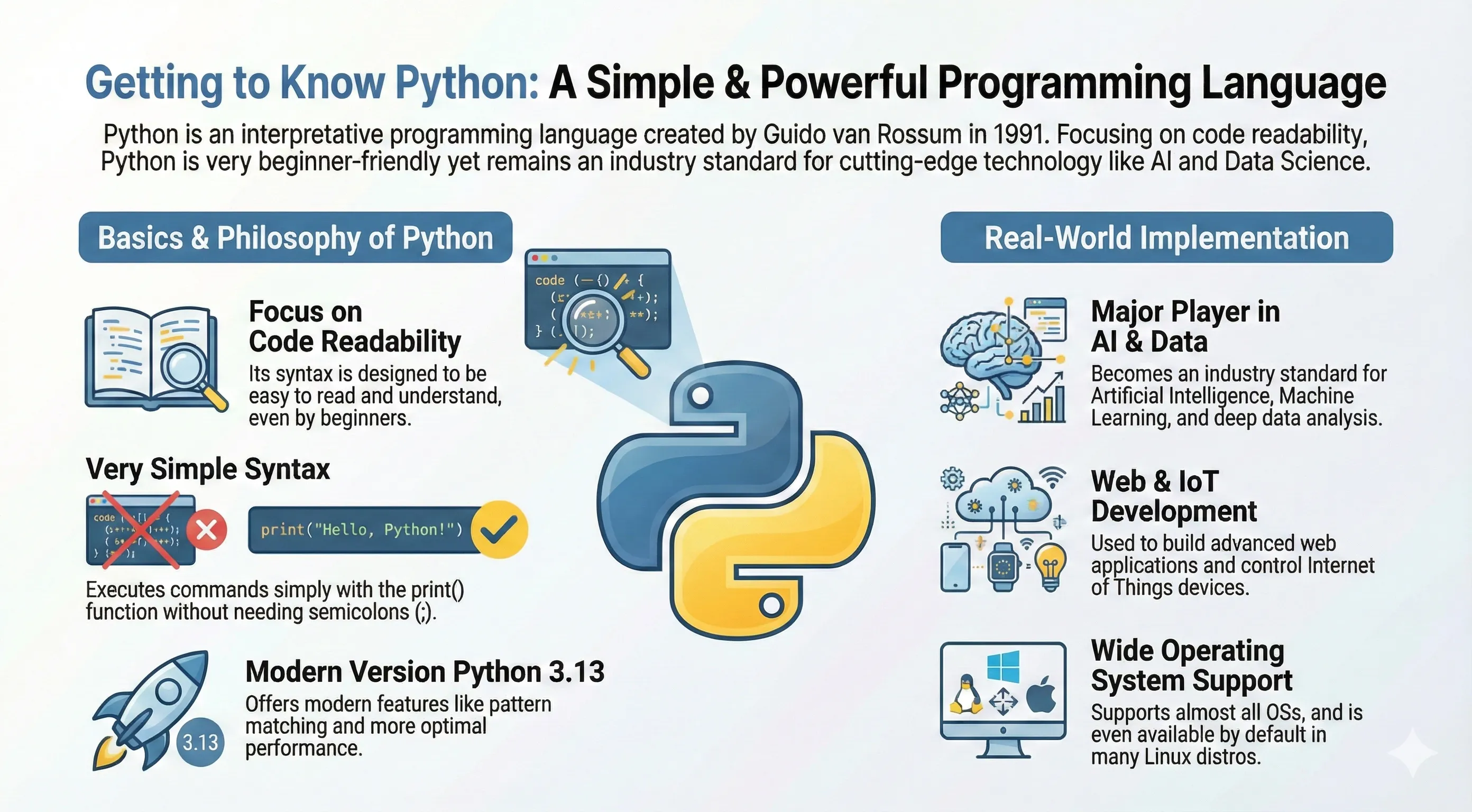
Python is a general-purpose interpreted programming language. Python is designed to be readable, expressive, and practical for everyday software development. Its straightforward syntax makes Python approachable for beginners while remaining powerful enough for large-scale production systems.
The language was first released in 1991 by Guido van Rossum, and it is maintained by the Python Software Foundation.
Python is widely used in:
- Automation and scripting: automating repetitive tasks and system administration
- Web development: frameworks like Django, Flask, and FastAPI
- Data science and machine learning: libraries like Pandas, NumPy, scikit-learn, TensorFlow, and PyTorch
- Scientific computing: SciPy, Matplotlib, and Jupyter notebooks
- DevOps and backend services: cloud tooling, CI/CD pipelines, infrastructure automation
- IoT and embedded devices: Raspberry Pi, MicroPython
Python runs on all major operating systems (Windows, macOS, Linux) and most Linux distributions ship with Python pre-installed.
This tutorial series is written for the Python 3.13 language and standard library.
print("Python is simple and powerful")
Python uses clean syntax and significant indentation. You do not need semicolons at the end of each line.