


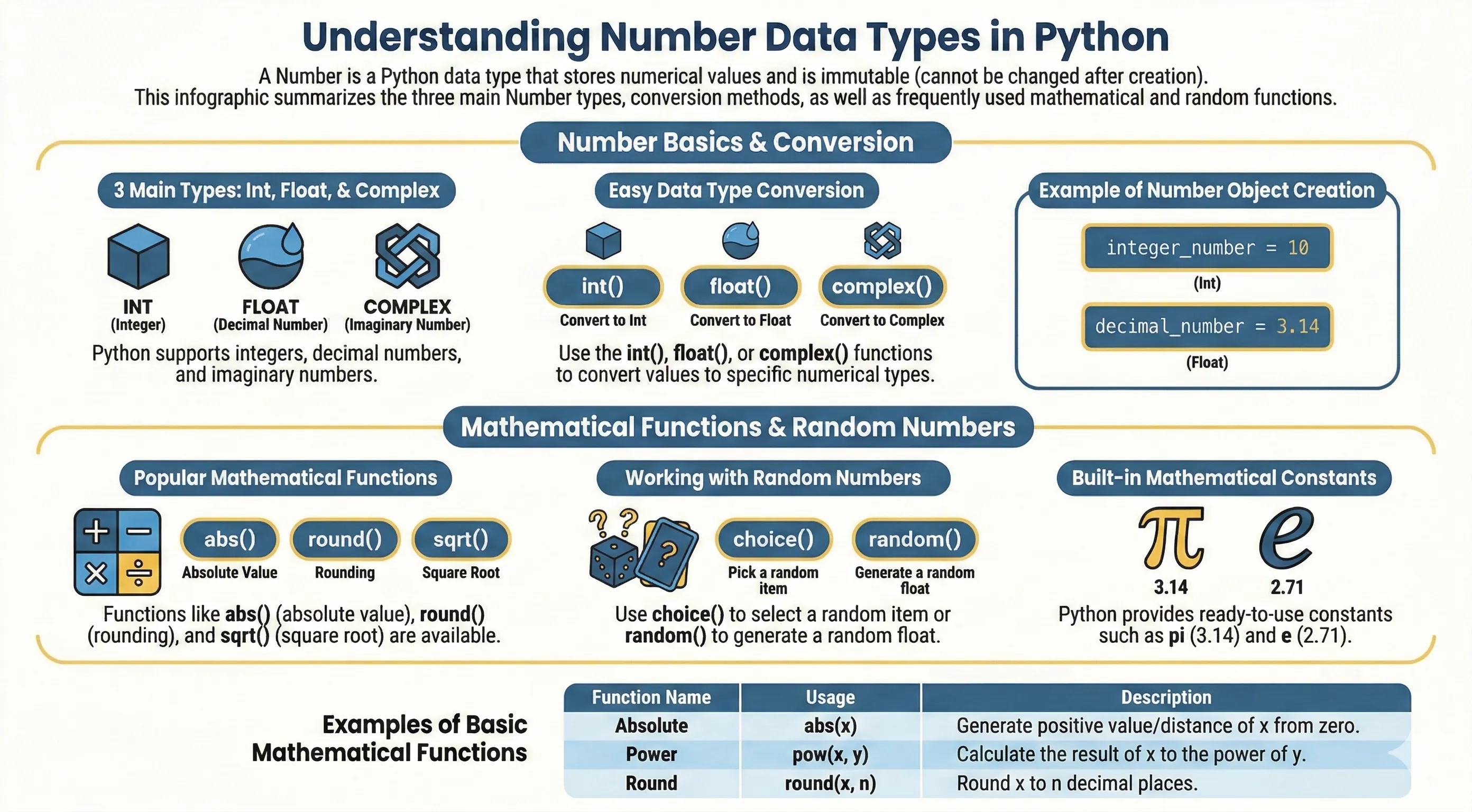
Python has three built-in numeric types:
int(integer)float(floating-point)complex(complex numbers)
Numbers are immutable: changing a number value creates a new object.
| Type | Examples |
|---|---|
int |
20, -13, 0, 0x56 |
float |
0.1, 1.20, -92.0, 6.02e23 |
complex |
3+4j, 35j, 3.12e-12j |
In Python 3, integer literals like
020are invalid. Use20for decimal or0o24for octal.
Python Number Data Type Conversion
Use built-in constructors for conversion:
int(x)convertsxto integer.float(x)convertsxto floating-point number.complex(x)convertsxto complex number with real partx.complex(x, y)converts to complex numberx + yj.
Python Mathematical Functions
Python provides built-ins and the math module for mathematical operations.
| Name | Usage | Explanation |
|---|---|---|
| Absolute | abs(x) |
Absolute value of x |
| Power | pow(x, y) |
Equivalent to x ** y |
| Round | round(x, n) |
Rounds to n digits (or nearest integer if omitted) |
| Maximum | max(a, b, ...) |
Largest value |
| Minimum | min(a, b, ...) |
Smallest value |
| Square Root | math.sqrt(x) |
Square root of x |
| Ceiling | math.ceil(x) |
Smallest integer >= x |
| Floor | math.floor(x) |
Largest integer <= x |
| Logarithm | math.log(x) |
Natural logarithm |
import math

print(abs(-9))
print(pow(2, 5))
print(round(3.14159, 2))  # 3.14
print(math.sqrt(16))
Python Random Number Functions
The random module is often used in simulations, tests, and games.
| Name | Usage | Explanation |
|---|---|---|
| Choice | choice(seq) |
Random item from sequence |
| RandRange | randrange(start, stop, step) |
Random value from range |
| Random | random() |
Random float in [0.0, 1.0) |
| Seed | seed(x) |
Set random seed |
| Shuffle | shuffle(lst) |
Shuffle list in place |
| Uniform | uniform(x, y) |
Random float in [x, y] |
Python Trigonometric Functions
math provides trigonometric helpers:
| Name | Usage | Explanation |
|---|---|---|
| Cosine | math.cos(x) |
Cosine of x in radians |
| Sine | math.sin(x) |
Sine of x in radians |
| Tangent | math.tan(x) |
Tangent of x in radians |
| Degrees | math.degrees(x) |
Convert radians to degrees |
| Radians | math.radians(x) |
Convert degrees to radians |
Python Mathematical Constants
| Name | Usage | Explanation |
|---|---|---|
| Pi | math.pi |
Mathematical constant pi |
| e | math.e |
Mathematical constant e |
Floating-Point Arithmetic: Representation and Limits
Floating-point numbers are binary approximations, so some decimal values cannot be represented exactly.
print(0.1 + 0.1 + 0.1)     # 0.30000000000000004
print(0.1 + 0.1 + 0.1 == 0.3)  # False
Use safer comparisons:
import math

print(math.isclose(0.1 + 0.1 + 0.1, 0.3))  # True
For exact decimal arithmetic (for example, money), use decimal:
from decimal import Decimal

price = Decimal("0.1") + Decimal("0.1") + Decimal("0.1")
print(price == Decimal("0.3"))  # True
For exact fractions, use fractions.Fraction:
from fractions import Fraction

print(Fraction(1, 10) * 3 == Fraction(3, 10))  # True
Notes on round()
Python uses "round half to even" for ties:
print(round(0.5))  # 0
print(round(1.5))  # 2
print(round(2.5))  # 2