


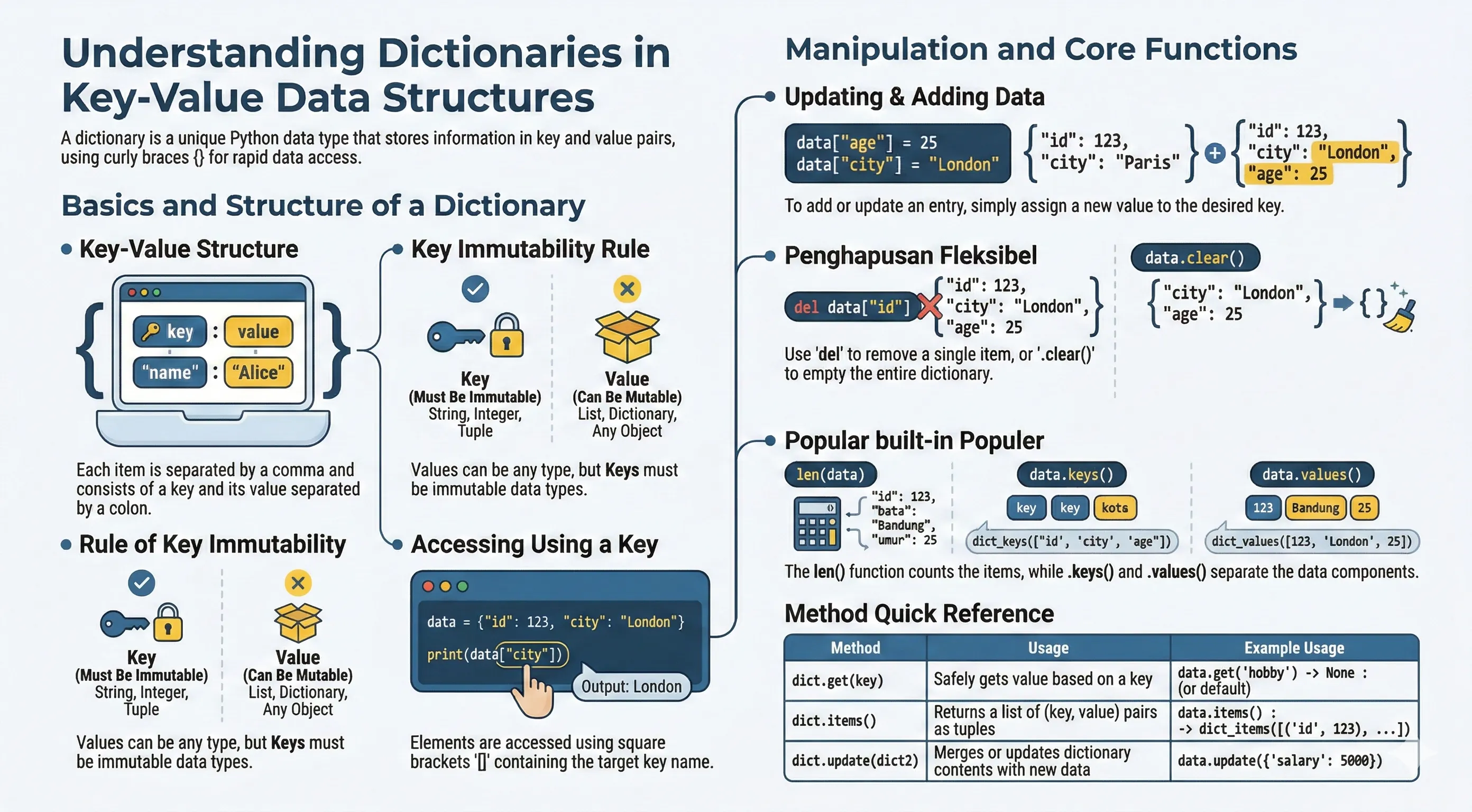
Python dictionary is different from List or Tuple. Because each sequence contains key and value. Each key is separated from its value by a colon (:), the items are separated by commas, and the whole thing is enclosed in curly braces. An empty dictionary without items is written with just two curly braces, like this: {}.
Dictionary keys can be of any type, but keys must be of an immutable data type such as strings, numbers, or tuples.
Accessing Values in Python Dictionary
To access Dictionary elements, you can use the familiar square brackets along with the key to obtain its value. Here is a simple example :
Avoid naming a variable dict, because that shadows Python's built-in dict(). Use a descriptive name instead:
#Example how to create Dictionary in Python

person = {'Name': 'Zara', 'Age': 7, 'Class': 'First'}
print("person['Name']: ", person['Name'])
print("person['Age']: ", person['Age'])
Safe Access with get()
Reading a missing key with square brackets raises a KeyError. The get() method returns None (or a default you choose) instead, which is safer:
person = {'Name': 'Zara', 'Age': 7}

print(person.get('Name'))          # Zara
print(person.get('City'))          # None
print(person.get('City', 'N/A'))   # N/A
Checking if a Key Exists
Use the in operator to test for a key before accessing it:
person = {'Name': 'Zara', 'Age': 7}

print('Name' in person)       # True
print('City' in person)       # False
print('City' not in person)   # True
Looping Over a Dictionary
You can iterate over keys, values, or both key-value pairs at once:
person = {'Name': 'Zara', 'Age': 7, 'Class': 'First'}

for key in person:                 # keys by default
    print(key)

for value in person.values():      # values
    print(value)

for key, value in person.items():  # key and value together
    print(key, "->", value)
Updating Values in Python Dictionary
You can update a Dictionary by adding a new entry or a key-value pair, modifying an existing entry, or deleting an existing entry as shown in the simple example given below.
#Update python dictionary

person = {'Name': 'Zara', 'Age': 7, 'Class': 'First'}
person['Age'] = 8  # Modify existing entry
person['School'] = "High School"  # Add new entry

print("person['Age']: ", person['Age'])
print("person['School']: ", person['School'])
Deleting Python Dictionary Elements
You can either remove individual dictionary elements or clear the entire contents of a dictionary. You can also delete entire dictionary in a single operation.
To explicitly remove an entire dictionary, just use the del statement. Here is a simple example :
#Example how to delete in Python Dictionary

person = {'Name': 'Zara', 'Age': 7, 'Class': 'First'}

del person['Name']  # remove a single entry by key
print("After deleting 'Name': ", person)

person.clear()  # remove all entries, keeping the empty dictionary
print("After clear(): ", person)

del person  # delete the dictionary object entirely
# Referencing `person` after this line would raise a NameError.
Built-in Functions on Python Dictionary
Python includes built-in functions as follows :
| Python Function | Explanation |
|---|---|
len(dict) |
Gives the total length of the dictionary. This would be equal to the number of items in the dictionary. |
str(dict) |
Produces a printable string representation of a dictionary |
type(variable) |
Returns the type of the passed variable. If passed variable is dictionary, then it would return a dictionary type. |
Built-in Methods on Python Dictionary
Python includes built-in methods as follows :
| Python Method | Explanation |
|---|---|
dict.clear() |
Removes all elements of dictionary |
dict.copy() |
Returns a shallow copy of dictionary |
dict.fromkeys() |
Create a new dictionary with keys from seq and values set to value. |
dict.get(key, default=None) |
For key, returns value or default if key not in dictionary |
dict.items() |
Returns a view of the dictionary's (key, value) tuple pairs |
dict.keys() |
Returns a view of the dictionary's keys |
dict.setdefault(key, default=None) |
Similar to get(), but will set dict[key]=default if key is not already in dict |
dict.update(dict2) |
Adds dictionary dict2's key-values pairs to dict |
dict.values() |
Returns a view of the dictionary's values |