


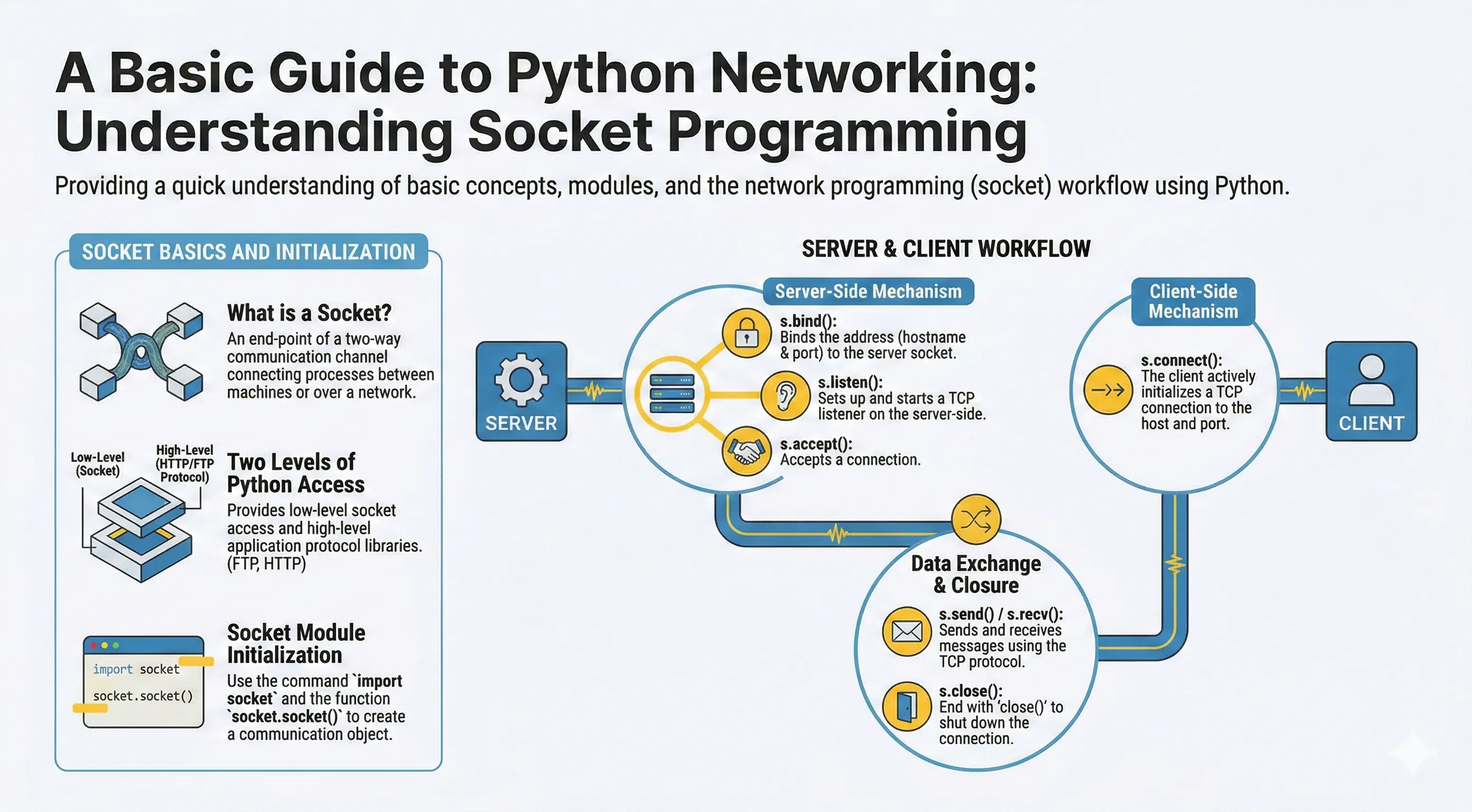
Python provides low-level and high-level networking modules.
- Low-level:
socketfor TCP/UDP clients and servers - High-level:
urllib,http.client,smtplib,imaplib,ftplib, and others
Start with low-level sockets to understand the basics, then use higher-level libraries for production applications.
What is Socket?
A socket is an endpoint for two-way communication between programs. Sockets can communicate between processes on the same machine or across different machines on a network.
Socket Module
Create a socket with:
socket.socket(family=AF_INET, type=SOCK_STREAM)
AF_INETfor IPv4SOCK_STREAMfor TCPSOCK_DGRAMfor UDP
SOCK_STREAM (TCP) is reliable and ordered. SOCK_DGRAM (UDP) is faster but does not guarantee delivery.
Server Socket Methods
| Method | Explanation |
|---|---|
bind() |
Bind address (host, port) to socket |
listen() |
Start listening for incoming TCP connections |
accept() |
Accept incoming connection and return (conn, addr) |
Client Socket Methods
| Method | Explanation |
|---|---|
connect() |
Connect to TCP server |
General Socket Methods
| Method | Explanation |
|---|---|
recv() |
Receive bytes |
sendall() |
Send all bytes |
recvfrom() |
Receive UDP packet |
sendto() |
Send UDP packet |
close() |
Close socket |
Simple TCP Server
This minimal server accepts one client connection, sends a response once, and exits.
# non-runnable: requires external environment/setup
import socket

HOST = "127.0.0.1"
PORT = 12345

with socket.socket(socket.AF_INET, socket.SOCK_STREAM) as s:
    s.bind((HOST, PORT))
    s.listen()
    print(f"Server listening on {HOST}:{PORT}")

    conn, addr = s.accept()
    with conn:
        print("Connected by", addr)
        conn.sendall(b"Thank you for connecting")
Simple TCP Client
# non-runnable: requires external environment/setup
import socket

HOST = "127.0.0.1"
PORT = 12345

with socket.socket(socket.AF_INET, socket.SOCK_STREAM) as s:
    s.settimeout(5)  # seconds
    s.connect((HOST, PORT))
    data = s.recv(1024)

print(data.decode("utf-8"))
Run server first, then run client from another terminal.
Common Python Internet Modules
| Protocol | Default Port | Python Module |
|---|---|---|
| HTTP | 80 | urllib.request, http.client |
| HTTPS | 443 | urllib.request, http.client |
| FTP | 21 | ftplib |
| SMTP | 25 / 587 | smtplib |
| POP3 | 110 | poplib |
| IMAP4 | 143 | imaplib |
| XML-RPC | (over HTTP) | xmlrpc.client |
For production systems, prefer higher-level libraries when appropriate and always add timeout handling.
Common Errors
ConnectionRefusedError: server is not running or wrong host/port.- Client hangs on
recv(): no timeout configured and server sends no data. OSError: [Errno 98] Address already in use: previous process still holds the port.- Mixing
strandbytes: sockets send/receive bytes, so encode/decode explicitly.