

Arrays are contiguous blocks of memory. In Python, list behaves like a dynamic array: random access is fast, and append is usually fast.
Book alignment (Chapter 3: Arrays and Vectors)
From the Necaise book, this page maps to:
3.1array structure and index-based access.3.4vector ADT (growable sequence container).3.5expandable container design (capacity growth, copy on resize).3.6vector implementation details.
The key design point is to separate:
- logical length (
size) and - allocated storage (
capacity).
That separation explains why appends are amortized O(1).
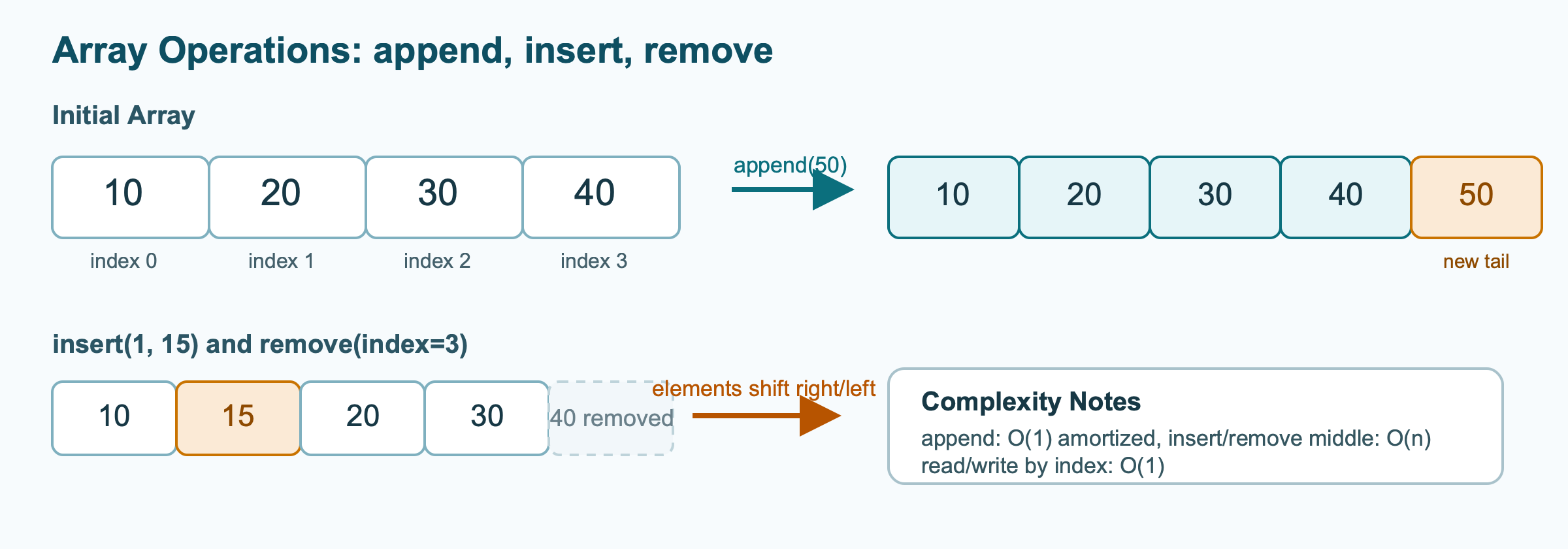
Mental model
Keep these ideas clear:
size: number of valid elements.capacity: allocated slots (often larger thansize).- Resize happens occasionally and copies data, which makes append amortized
O(1).
When to use arrays
- You need direct indexing by position.
- You scan data from left to right.
- You use pattern-based techniques such as two pointers or sliding window.
- You want cache-friendly, contiguous storage.
When not to use arrays
- You do frequent middle inserts/deletes in hot code paths.
- You need fast prepend (
dequeis usually better). - You need stable references to nodes while rearranging structure (linked structures are easier).
Operations
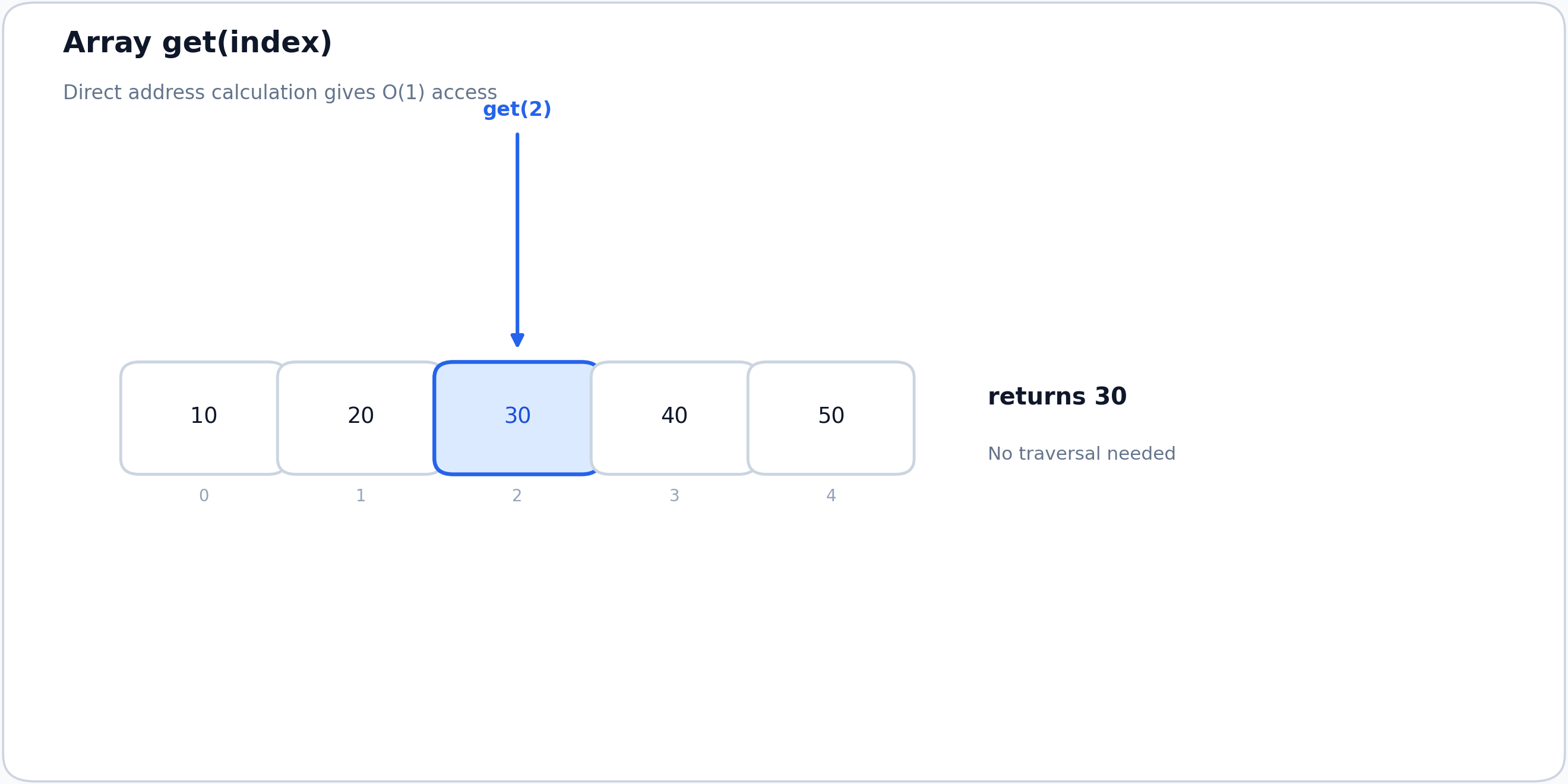
get(index)
Array memory is contiguous, so the element address is computed directly from index. No traversal is needed.
def get(self, index):
    if index < 0 or index >= len(self.data):
        raise IndexError("index out of range")
    return self.data[index]
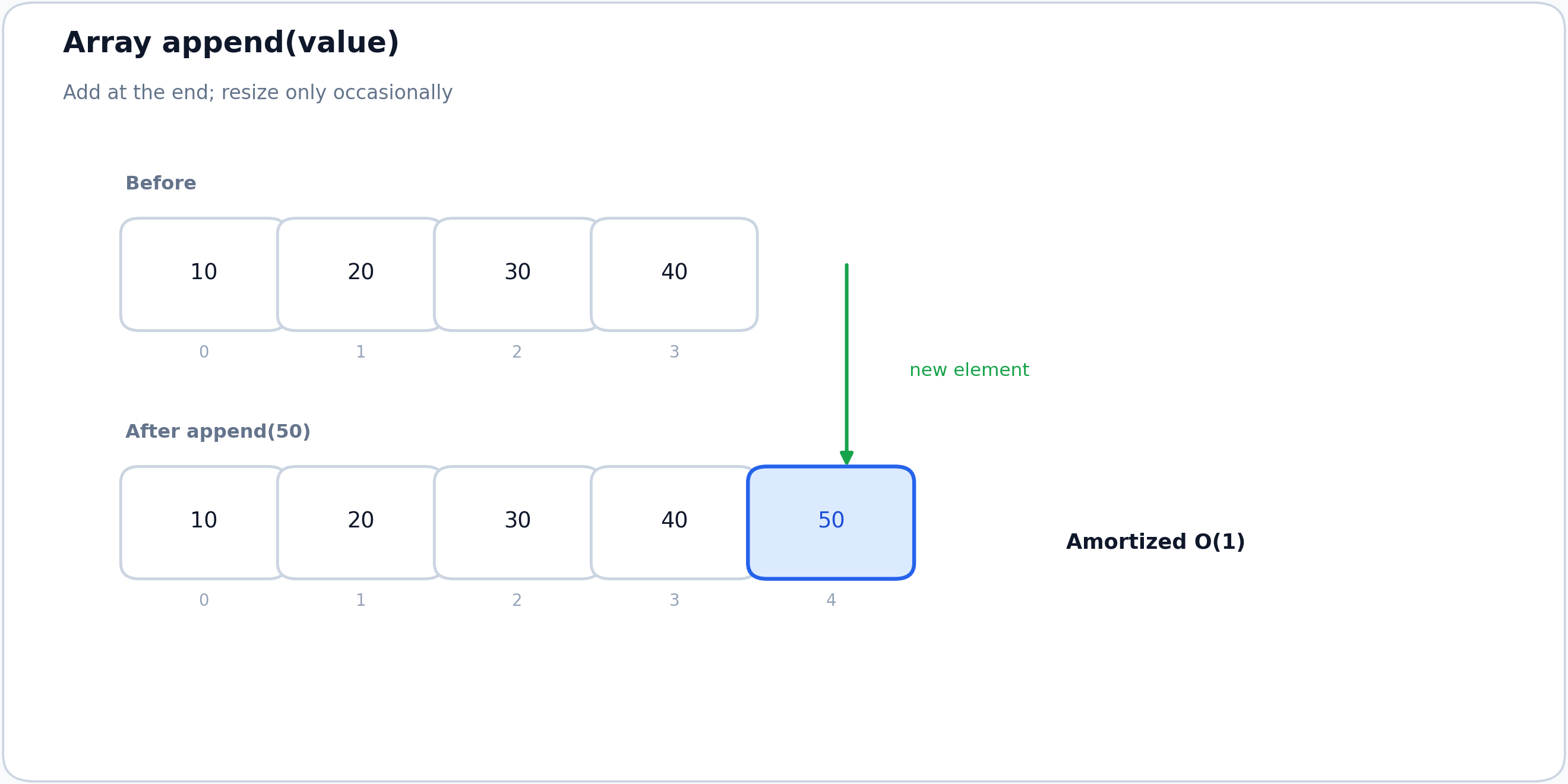
append(value)
append places the value at the end. Most appends are constant time. Rarely, the backing storage grows and copies data, which gives amortized O(1).
def append(self, value):
    self.data.append(value)
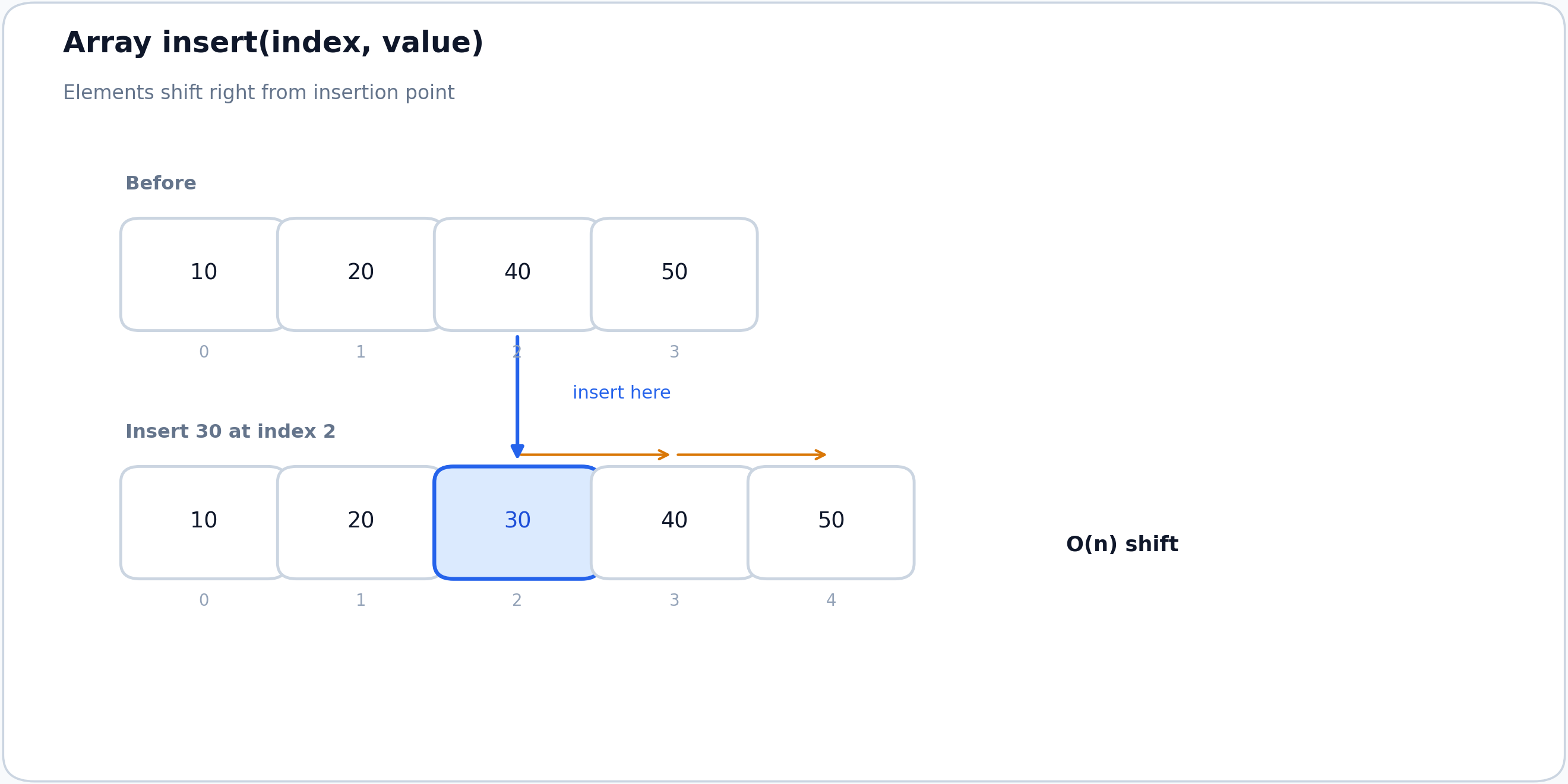
insert(index, value)
Elements from index to the end shift right by one slot, then the new value is placed at index. Cost is linear in the number of shifted elements.
def insert(self, index, value):
    if index < 0 or index > len(self.data):
        raise IndexError("index out of range")
    self.data.insert(index, value)
delete(index)
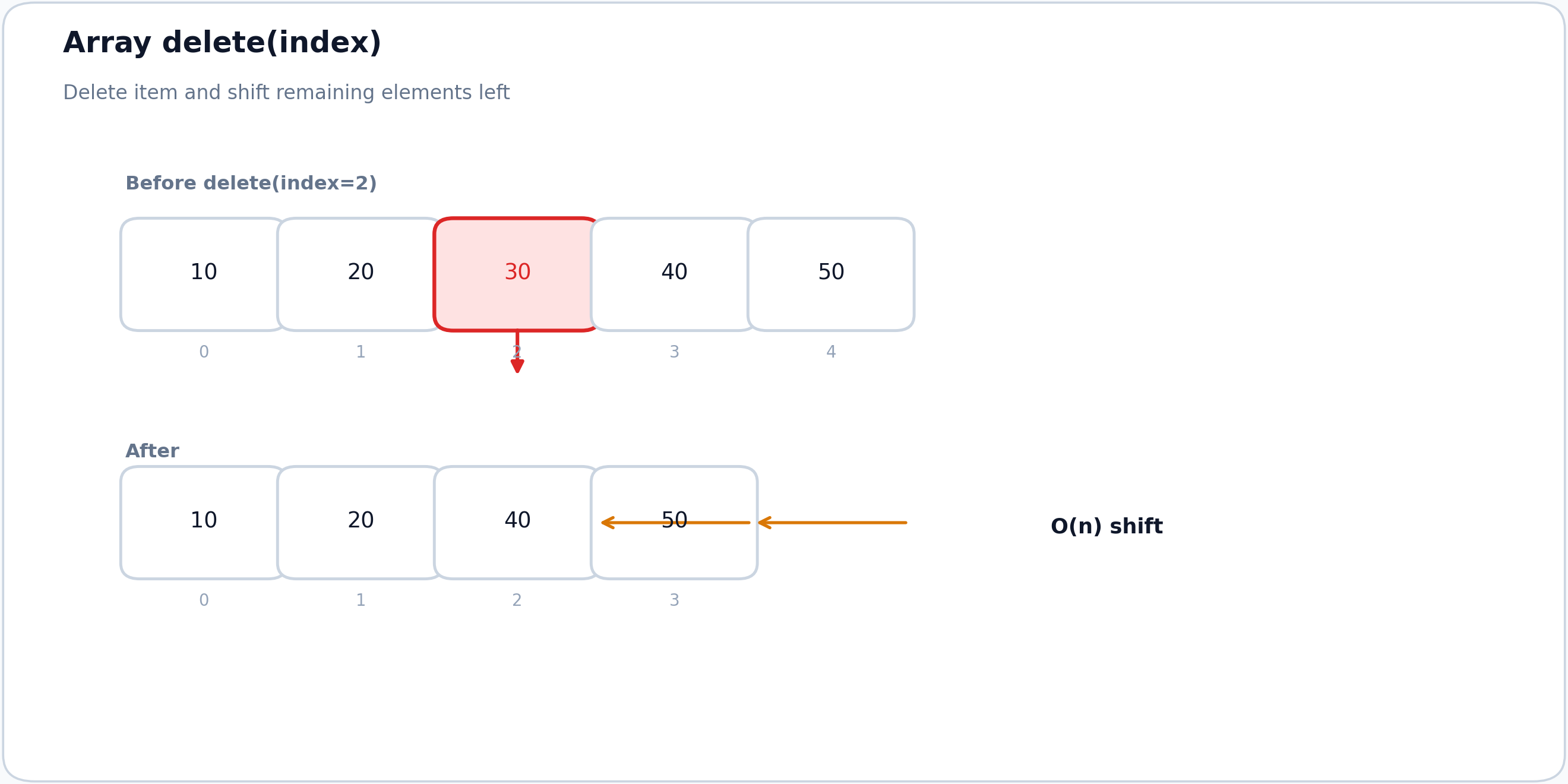
Element at index is removed, and all later elements shift left by one slot.
def delete(self, index):
    if index < 0 or index >= len(self.data):
        raise IndexError("index out of range")
    return self.data.pop(index)
Full implementation
class DynamicArray:
    def __init__(self):
        self.data = []

    def append(self, value):
        self.data.append(value)

    def get(self, index):
        if index < 0 or index >= len(self.data):
            raise IndexError("index out of range")
        return self.data[index]

    def set(self, index, value):
        if index < 0 or index >= len(self.data):
            raise IndexError("index out of range")
        self.data[index] = value

    def insert(self, index, value):
        if index < 0 or index > len(self.data):
            raise IndexError("index out of range")
        self.data.insert(index, value)

    def delete(self, index):
        if index < 0 or index >= len(self.data):
            raise IndexError("index out of range")
        return self.data.pop(index)

    def __len__(self):
        return len(self.data)

    def __repr__(self):
        return f"DynamicArray({self.data})"
Complexity summary
| Operation | Time | Why |
|---|---|---|
| Read by index | O(1) |
Direct address calculation |
| Update by index | O(1) |
Overwrite existing slot |
| Append | O(1) amortized |
Occasional resize and copy |
| Insert in middle | O(n) |
Shift right |
| Delete in middle | O(n) |
Shift left |
| Search unsorted array | O(n) |
Sequential scan |
Common patterns
Two pointers
Useful for sorted arrays and palindrome checks. One pointer starts at the beginning and the other at the end; they move toward each other.
def is_palindrome(s):
    left, right = 0, len(s) - 1
    while left < right:
        if s[left] != s[right]:
            return False
        left += 1
        right -= 1
    return True
- Time:
O(n) - Space:
O(1)
Sliding window
Track a running window of size k to avoid repeated summing. Shift the window one step at a time.
def max_sum_k(nums, k):
    if k > len(nums):
        return None

    window_sum = sum(nums[:k])
    best = window_sum

    for i in range(k, len(nums)):
        window_sum += nums[i] - nums[i - k]
        best = max(best, window_sum)

    return best
- Time:
O(n) - Space:
O(1)
Frequency counting
Count occurrences of each element. Useful for anagram checks, duplicate detection, and histogram problems.
def is_anagram(a, b):
    if len(a) != len(b):
        return False

    count = {}
    for ch in a:
        count[ch] = count.get(ch, 0) + 1

    for ch in b:
        if ch not in count:
            return False
        count[ch] -= 1
        if count[ch] < 0:
            return False

    return True
- Time:
O(n) - Space:
O(n)
Prefix sums
Precompute cumulative sums to answer range-sum queries in O(1) after O(n) setup.
def build_prefix(nums):
    prefix = [0] * (len(nums) + 1)
    for i in range(len(nums)):
        prefix[i + 1] = prefix[i] + nums[i]
    return prefix


def range_sum(prefix, left, right):
    return prefix[right + 1] - prefix[left]
- Setup:
O(n) - Query:
O(1)
Edge-case checklist
- Bounds checks for all index-based methods.
- Empty array behavior for delete/read.
k > len(nums)style guard for window algorithms.- Large inputs where repeated middle insert/delete may dominate runtime.
Typical mistakes
- Forgetting bounds checks.
- Using middle insert in hot paths where linked list or
dequemay be better. - Assuming append is always strict
O(1)instead of amortizedO(1).