

A heap is a complete binary tree stored in an array.
- Min-heap: parent value is less than or equal to child values.
- Max-heap: parent value is greater than or equal to child values.
Book alignment
The priority-queue ADT appears in Chapter 8 (Queues) in the Necaise book.
This page extends that material with a heap-based implementation, which is the standard production strategy.
Priority queues are usually built on top of heaps.
Heap invariants
- Shape invariant: tree is complete (filled level by level, left to right).
- Order invariant (min-heap): parent is always less than or equal to each child.
Index mapping in array-based heap
parent(i) = (i - 1) // 2left(i) = 2 * i + 1right(i) = 2 * i + 2
Operations
push(value)
Append to the end, then sift up while heap property is violated.
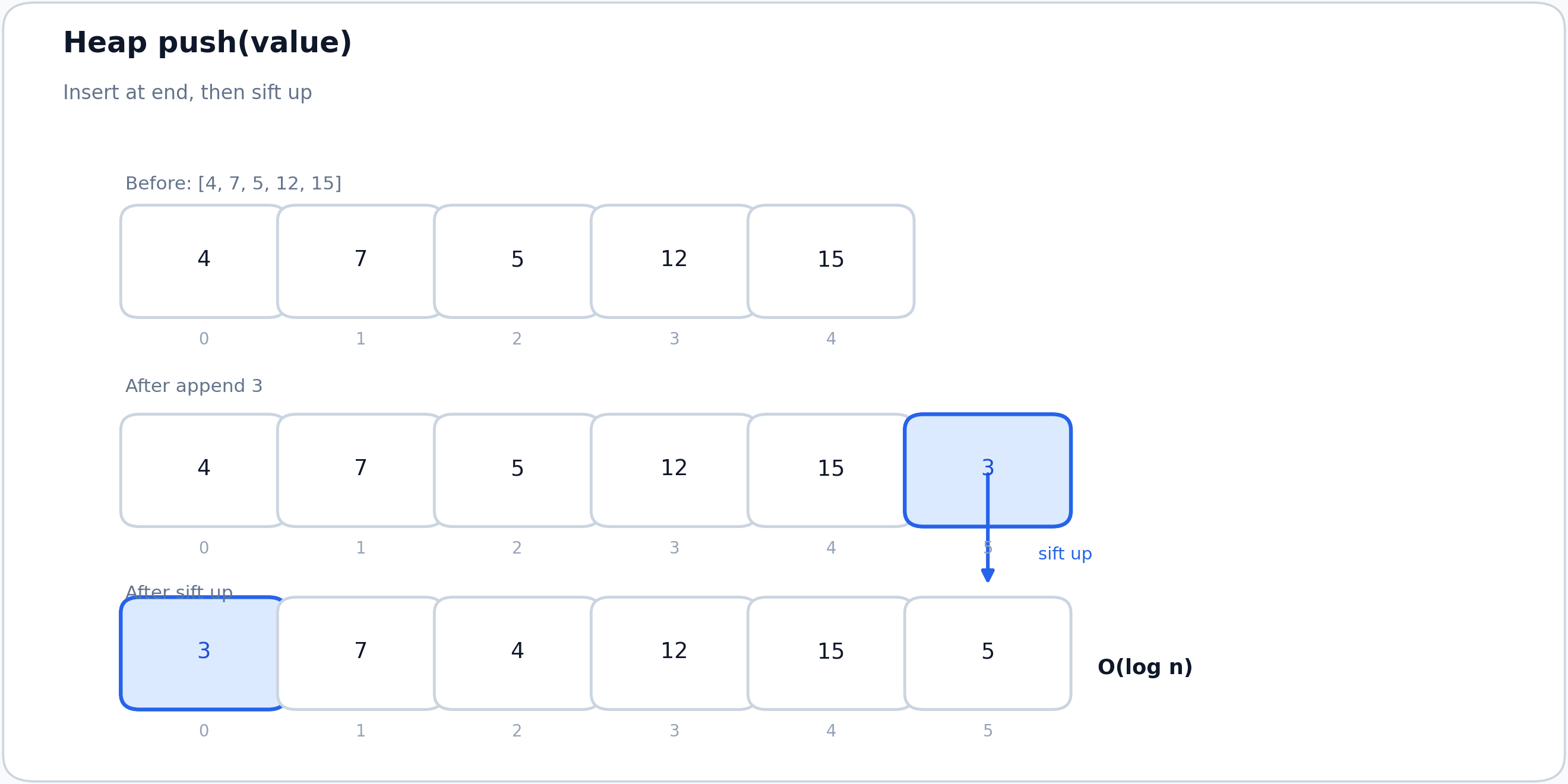
def push(self, value):
    self.data.append(value)
    self._sift_up(len(self.data) - 1)
pop()
Remove root, move last element to root, then sift down until heap property is restored.
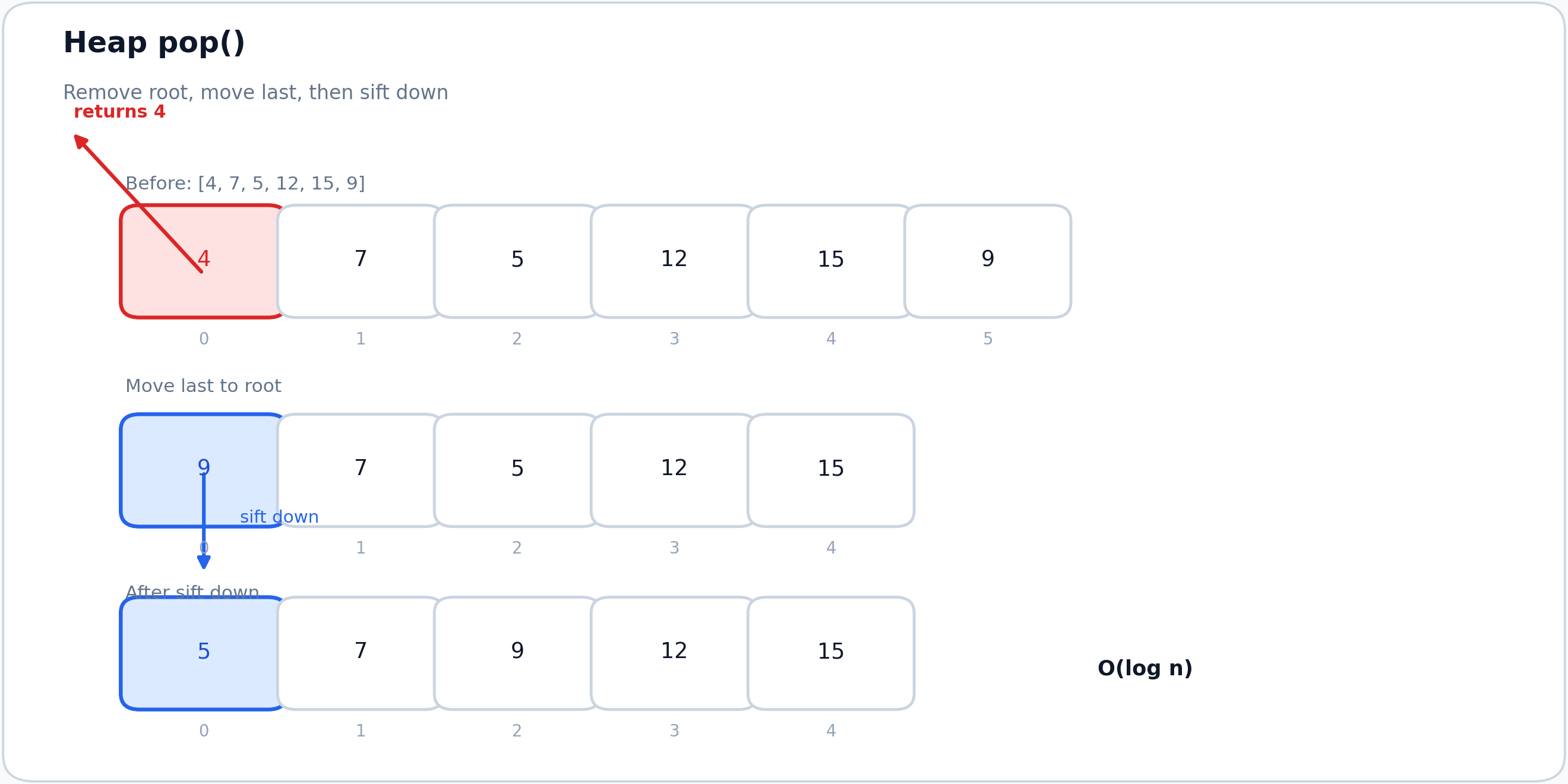
def pop(self):
    if not self.data:
        raise IndexError('pop from empty heap')

    root = self.data[0]
    last = self.data.pop()
    if self.data:
        self.data[0] = last
        self._sift_down(0)
    return root
peek()
Return the root element. In min-heap this is the smallest value.
def peek(self):
    if not self.data:
        raise IndexError('peek from empty heap')
    return self.data[0]
Full implementation
class MinHeap:
    def __init__(self):
        self.data = []

    def _parent(self, i):
        return (i - 1) // 2

    def _left(self, i):
        return 2 * i + 1

    def _right(self, i):
        return 2 * i + 2

    def push(self, value):
        self.data.append(value)
        self._sift_up(len(self.data) - 1)

    def pop(self):
        if not self.data:
            raise IndexError('pop from empty heap')

        root = self.data[0]
        last = self.data.pop()
        if self.data:
            self.data[0] = last
            self._sift_down(0)
        return root

    def peek(self):
        if not self.data:
            raise IndexError('peek from empty heap')
        return self.data[0]

    def _sift_up(self, i):
        while i > 0:
            parent = self._parent(i)
            if self.data[parent] <= self.data[i]:
                return
            self.data[parent], self.data[i] = self.data[i], self.data[parent]
            i = parent

    def _sift_down(self, i):
        n = len(self.data)
        while True:
            left = self._left(i)
            right = self._right(i)
            smallest = i

            if left < n and self.data[left] < self.data[smallest]:
                smallest = left
            if right < n and self.data[right] < self.data[smallest]:
                smallest = right

            if smallest == i:
                return

            self.data[i], self.data[smallest] = self.data[smallest], self.data[i]
            i = smallest
Build heap in linear time
If you already have an array, bottom-up heapify builds a heap in O(n).
def heapify(nums):
    h = MinHeap()
    h.data = nums[:]  # copy

    start = (len(h.data) // 2) - 1
    for i in range(start, -1, -1):
        h._sift_down(i)
    return h
Priority queue pattern
Use tuples (priority, payload) so the smallest priority is popped first.
h = MinHeap()
h.push((2, "email"))
h.push((1, "payment"))
print(h.pop())  # (1, "payment")
For equal priorities, include a tie-breaker counter if stable ordering matters.
Complexity summary
| Operation | Time |
|---|---|
| Push | O(log n) |
| Pop | O(log n) |
| Peek | O(1) |
| Build heap | O(n) |
Typical uses
- Dijkstra shortest path.
- Scheduling by priority or deadline.
- Top-k problems on streams.
Typical mistakes
- Assuming heap array is globally sorted (it is not).
- Forgetting empty-heap checks before
pop/peek. - Using heap when frequent arbitrary deletions are required.